According to linguist Jay Keyser,[1] in his book The Mental Life of Modernism: Why Poetry, Painting, and Music Changed at the Turn of the Twentieth Century,[2] the arts (painting, music, and poetry) abandoned the rules by which they had been made throughout their history and changed the parameters by which they were meant to be…
What Turned the Arts Upside Down?



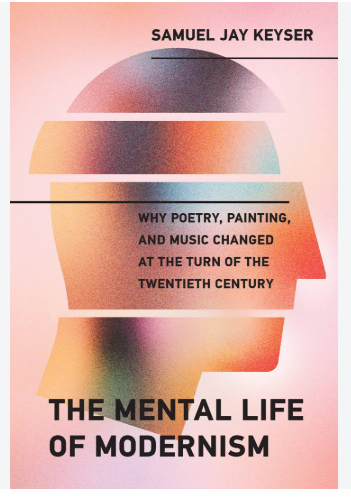
According to linguist Jay Keyser,[1] in his book The Mental Life of Modernism: Why Poetry, Painting, and Music Changed at the Turn of the Twentieth Century,[2] the arts (painting, music, and poetry) abandoned the rules by which they had been made throughout their history and changed the parameters by which they were meant to be perceived. The “sister arts,” as he calls them, went from being understandable and pleasurable to becoming riddles that had to be deciphered.
For Keyser, the human brain has a natural aesthetic: a set of rules that, though unconscious, help us interpret, value, and judge what we perceive. Artists know these rules intuitively, and so do spectators. The rules are not arbitrary. They arise from our biological and cognitive predispositions, such as the capacity for language, the visual processing of faces and landscapes, or the perception of meter and tonal scales. The pleasure these art forms provided depended on a “common grammar,” which operates when the brain recognizes and processes patterns fluently.
In his book, Keyser does not mention the philosopher Hans-Georg Gadamer (1900–2002), but he shares something fundamental with him when it comes to judging the new artistic expressions of the twentieth century: the idea that they are taken up as a game. For Gadamer, a work of art is neither a passive object nor a mere creation of the artist, but an autonomous game that plays itself, with its own internal rules that impose themselves on the participants. When we enter the game (or the experience of these art forms), we do not impose our subjective rules, but submit to the particular dynamic the work offers us. These rules are like those of chess or soccer: they stand above the individual players. The work demands to be played under its own norms of meaning and interpretation. As Keyser puts it: “Making art has much in common with playing games. Both need rules. Without rules, there can be no game and, as we shall see, no art either” (p. 29).
For Keyser, the total upheaval of the arts that we call Modernism happened for several reasons:
By the end of the nineteenth century, art and science had reached a barren point. The natural limits of the brain had been explored, and every possible variation had been tried to create novelty, attract attention, and captivate (in the arts), as well as to explain reality (in the sciences). In the arts, nothing remained but small changes on the same thing (which was boring), while science had explained, within its natural limits, everything that could be explained (and so came to a halt). Through the use of more sophisticated languages, intellectual artifacts, so to speak, abstract systems and non-intuitive theoretical formulations were invented (such as algebra and quantum mechanics to explain reality, or atonality to write music). In the arts, the concept itself was proposed as the work: emptiness, silence, the loss of rhythm, meter, order, and harmony, in order to captivate the spectator once again.
In poetry, rhyme, alliteration, and meter were disregarded. Rhyme and meter make use of stress, which plays a key role in alliteration, which in turn matters for rhyme, which matters for meter, and of course stress is intrinsic to every word. In fact, stress also seems to be linked to our motor system.
Keyser says that Fred Lerdahl and Ray Jackendoff, in their book A Generative Theory of Tonal Music (1983), maintain that to understand music, the listener must share the rules with the composer. For Keyser, the situation is parallel to that of natural language, since speaker and listener share the same set of rules.
Poetry and painting are the counterpart of atonal music. In Keyser’s words: “Just as Ashbery and Duchamp offer a disconnected set of images in search of a narrative, atonal music offers an arbitrary set of tones in search of a musical structure. Schoenberg’s Six Pieces, not without appeal, are perceived as a series of disconnected musical gestures” (p. 127).
Regarding painting, he states that the brain is equipped to observe landscapes, streets, and buildings with special care, since the environment is an important and valuable stimulus for survival. The brain does not react the same way to everyday objects. It does react to bodies, human faces, and landscapes, because they activate specialized areas of the brain. This idea is held by the neurologist Anjan Chatterjee in his book The Aesthetic Brain.

Georg Baselitz
Chatterjee agrees with Keyser. According to him, natural selection plays a dominant role in our preferences for certain landscapes, and we respond positively to indicators of health or physical fitness, as well as to nature when we see fruit trees or flowering ones. There is a desire to improve or perfect. My book El arte al desnudo (Art Laid Bare) is based on this point shared with Chatterjee. We do not leave things as we find them, and once we define a function, we seek to perfect the artifact to improve various aspects of it. We use ornaments, cosmetics, and surgeries or procedures to enhance human beauty, and we arrange the environment with gardens, ponds, and paths to beautify the natural landscape.
Keyser’s main idea is that there is a natural aesthetic based on a system of rules that reflect what the human brain does spontaneously; but once the possibilities for going further, optimizing, or making variations have been exhausted, the natural rules must be replaced by artificial ones.
We created a new environment in which the arts become practically inaccessible, because they cease to be tangible objects that can be appreciated with the cognitive baggage we bring, turning instead into conceptual statements that require a specific context to be interpreted.
With Modernism, artists abandoned the common grammar shared by everyone and began to invent private, individual formats. The bewildered public had no choice but to try to forget what it knew and make an active intellectual effort to decipher the new parameters and play by new rules in each of the artistic modes.
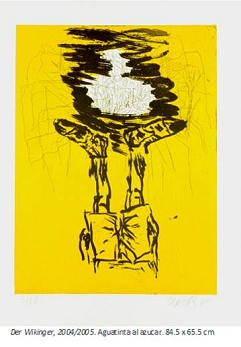
Georg Baselitz
Each work became a riddle to be uncovered or solved, finding in it a path to explore another kind of pleasure: that of understanding rather than contemplating.
For Chatterjee (2014, p. 106): “We experience pleasure when we make sense of things, an effect developmental psychologist Alison Gopnik whimsically called ‘explanation as orgasm’ (cf. Gopnik, 1998). Babies purse their lips and furrow their brows when presented with confusing problems. When they discover the answer, they smile and beam… So we have this reverberating cycle of pleasure that helps us learn, and what we have learned gives us pleasure. These cognitive pleasures may be the reason we experience pleasure with certain conceptual art. Figuring out what they mean stimulates our reward system.”
In the opening chapter, Keyser suggests that modernism is not entirely modern: it shares a crucial property with the seventeenth-century Newtonian revolution that unites both events under the same heading. It is the brain confronting its own limitations and the consequent need to develop coping strategies, that is, alternative solutions. Intelligible scientific theorizing was one of those strategies; the new artistic forms of the modernist creators were another.
In my opinion, explaining that abrupt change in the arts is not easy, since there is no way to empirically prove Keyser’s proposal. Even so, it seems sensible to think that artistic languages were running out of steam and that, since art constantly competes for the spectator’s attention, it became essential to offer innovations. On the other hand, it is impossible to know with certainty whether there is such a close relationship between the arts and the sciences; still, it is plausible to argue that changes in scientific paradigms permeated other cultural spheres and drove radical turns in artistic expression, turning it upside down.
[1]Samuel Jay Keyser (born 1935) is a renowned American theoretical linguist, academic, and author. He is Peter de Florez Professor Emeritus in the Department of Linguistics and Philosophy at the Massachusetts Institute of Technology (MIT), where he also served as department head and associate provost.
[2]The Mental Life of Modernism: Why Poetry, Painting, and Music Changed at the Turn of the Twentieth Century. MIT Press, Cambridge, Massachusetts, 2020.

Comparte tu opinión
Buscar en Blogs
Blogueros notables
Mas votados


Todos los Blogueros
- CastroOpina
Por @castroopina
- Los que sobran
Por @Cielo _Rusinque
- Coma Cuento: cocina sin enredos
Por @ComíCuento
- Tenis al revés
Por @JuanDiegoR
- A calzón quitao
Por A calzón Quitao
- La Guía Astral
Por ACA
- Lloronas de abril
- El Peatón
Por Albeiro Guiral
- Detrás de Interbolsa
Por Alberto Donadio
- Unidad Investigativa
Por Alberto Donadio
- Alejandro Pinto
Por Alejandro Pinto
- Cura de reposo
- ¿Se lo explico con plastilina?
Por alter eddie
- Un Blog para colorear
Por Alvaro J Tirado
- Voces por el Ambiente
- Catrecillo
- Relaciona2
Por ANDREA VILLATE
- Zona Mixta
- Bike The Way
Por Andrés Núñez
- Ventiundedos
- El invitado
Por antojarcu
- Ese extraño oficio llamado Diplomacia
- La tortuga y el patonejo
Por Baba
- Bajolamanga.co
Por Bajolamanga
- 300 GOTAS
Por Bastián Baena
- Con-versaciones
Por Bat&Man
- Corazón de mango
- Mi Opinión
Por Ben Bustillo
- Bernardo Congote
Por Bernardo Congote
- El Hilo de Ariadna
- El Río
Por Blog El Río
- Actualidad
- Un Punto de Cruz
Por buscobeca.com
- Mirabilia
- Cara o Sello
Por Caraoselloblog
- Dirección única
- Media & Marketing
Por Carlos Castillo
- Hundiendo teclas
- Colegio de Estudios Superiores de Administración
Por CESA
- La Sinfonía del Pedal
- Follamos, luego existimos
- Colirio
Por colirio
- Colombia de una
Por colombiadeuna
- El Mal Economista
Por columnistas eme
- Palabra Maestra
- Olas y Ecos
Por dafevid
- Mercadeando
- Filosofía y coyuntura
- En contra
Por Daniel Ferreira
- Blogs
Por Daniel Sarmiento
- Claudia Palacio
- De Sexo Hablemos
Por desexohablemos
- De ti habla la historia
- Plétora
- Las palabras y las cosas
Por Diego Aretz
- Yo veo
- Tejiendo Naufragios
Por Diego Niño
- Líneas de arena
- Desde la Academia
Por Economia
- Destellos de un mundo en mutación
- It was born in England
Por Eduardo Ustáriz
- Cuestión digital
Por Edwin Bohórquez
- El Mal Economista
- El MERIDIANO 82
Por El meridiano 82
- ESTADO DE COMA
Por Eliana Samacá
- El Magazín
Por elmagazin
- La vaca esférica
Por eltrinador
- El Mal Economista
Por EME
- Otro mundo es posible
Por Enrique Patiño
- Actualidad
- Gramófono cultural
- Tolima-Tolimán
Por FabiolaH
- La agenda del CFO
Por Felipe Jánica
- Dos o tres cosas que sé de cine
Por fgonzalezse
- República de colores
- Más que fotos
Por Gabriel Aponte
- La Franja De Gaso
Por Gaso
- cafeliterario.co
- Embrollo del Desarrollo
Por Gudynas Eduardo
- Hernán González R
- Calicanto
- Humedales Bogotá
Por humedalesbogota
- Ecuaciones de opinión
- Internet pa’l diario
- El bosque es vida- IRI Colombia
Por IRI Colombia
- Meditaciones Absurdas
- Deporte en letras
Por Iván Gutiérrez
- Pazifico, cultura y más
- Conversar, Sentir y Pensar…. Desde el SUR
- Parsimonia
Por Jarne
- Ciudad Sostenible
Por Jen Valentino
- Más allá de la medicina
Por jgorthos
- George o nomics
Por Jorge Borrero
- La droga, ¿y Colombia?
Por Jorge Colombo*
- Hypomnémata
- Si yo fuera
- Utopeando │@soyjuanctorres
- Minería sin escape
- Políticamente insurrecto
- Cosmopolita
- Inevitable
- En segunda fila
- Actualidad
- AdverGlitch
- Sobrevivir a la Edad Media
- A la Palestra
- Ready player number two
Por JuanDLink
- lado oculto radio
Por ladoocultoradio
- La revolución personal
- Las Ciencias Sociales Hoy
- Ciencia para el buen vivir
- Liarte: diálogo sobre arte
- Una habitación digital propia
- Los perdidos
Por losperdidos
- En jaque
- Reencuadres
Por Manuel J Bolívar
- Putamente libre – Feminismo Artesanal
Por Mar Candela
- LA CASA ENCENDIDA
- Psicoterapia y otras Posibilidades
Por María Clara Ruiz
- Política
Por Maria MesaR
- Bienestar en tiempos de drones
Por Maria Pasión
- Desde el fogón
Por Maritornes
- Consideraciones políticas
Por Maylor Caicedo
- Ella es la Historia
Por Milanas Baena
- Mongabay Latam
Por Mongabay Latam
- Ojo de pez
Por Mónica Diago
- Nadimcomics
Por nadimcomics
- NTT DATA: Tendencias disruptivas y nuevos modelos
- Con los pies en la tierra
- Tributos y Atributos
Por OSWALDO PEÑA
- El telescopio
Por Pablo de Narváez
- PauLab Laboratorio Digital / Un clic hace la diferencia
- El Último Verso
Por pavelstev
- Lloviendo y haciendo sol
Por Pilar Posada S.
- Esto mejora, pero no cambia
- Actualidad
- El poder de la tecnología: Cómo nos cambia
Por Rafa Orduz
- La conspiración del olvido
- Don Ramón, psicología laboral
Por ramon_chaux
- Coyuntura Política
- Corazón de Pantaleón
Por ricardobada
- Reflexiones
Por RicardoGarcia
- DELOGA BRUSTO
- Apuntes de Ciencia
Por Santiago Franco
- La Acción Política de Educarse
Por Santiago Muñoz
- La Perla
Por Sebastián Gómez
- Óscar Sevillano
Por Sevillano
- Solteras DeBotas
Por Solteras DeBotas
- La cuestión animal
Por Steven Navarrete
- Tareas no hechas
Por tareasnohechas
- Tíbet de Suramérica
- El Cuento
- Blog de notas
Por Vicente Pérez
- El Blog del Cerebro
- Derecho para todos
- Conspirando por un mundo mejor


Los editores de los blogs son los únicos responsables por las opiniones, contenidos, y en general por todas las entradas de información que deposite en el mismo. Elespectador.com no se hará responsable de ninguna acción legal producto de un mal uso de los espacios ofrecidos. Si considera que el editor de un blog está poniendo un contenido que represente un abuso, contáctenos.