Translation by Kieran Tapsell Summary: The history of art shows gradual improvements in technique for representing our earthly reality. But over a hundred years ago, some artists began to throw out this long-standing tradition to turn canvasses with nothing or just one colour into art. Then they started to exhibit invisible sculptures. There was no…
Art That Glorifies Nothing



Translation by Kieran Tapsell
Summary: The history of art shows gradual improvements in technique for representing our earthly reality. But over a hundred years ago, some artists began to throw out this long-standing tradition to turn canvasses with nothing or just one colour into art. Then they started to exhibit invisible sculptures. There was no skill in any of this, but the artists did need powerful patrons in art galleries and amongst the critics to convince potential buyers that it was art.
It never ceases to amaze how irrational and herd like we human beings are. We lack courage when it comes to obeying the trends imposed on the world, no matter how absurd, banal, or silly they may be. Fashions in clothing and footwear demonstrate this to us every day, but also in the commercial and art worlds we find countless examples.
In 1883, the French artist collective “Les Incoherentes” proposed the concept of the empty canvas as a work of art. Later, in the 20th century, artists and those who validate them before the public and institutions abandoned traditions. A defiant attitude prevailed, the main idea of which was to innovate and transgress.
Artistic movements sprang up like flowers in fertile soil. Today’s movement replaced yesterday’s. Artists entered a game where each invented their own rules. The imperative was to forget the past and its works. Until then, art had been the result of a slow superposition of achievements and subtle changes within tradition. Dadaism, a European movement of 1916, opened the door to many trends.
Before some artists proposed emptiness, nothingness, as a work of art, others had already explored extreme simplification. Artists like Kazimir Malevich proposed single-color canvases, something akin to not painting anything at all. In 1918, he created his work White Square on a White Background, an extreme example of the movement (pure concept). Then, in 1921, Aleksander Rodchenko presented his monochromatic paintings: Pure Red, Pure Yellow, and Pure Blue.
In 1940, Ad Reinhardt’s Black Paintings arrived. More than 20 artists, from different parts of the world, have demonstrated their creativity by painting their unique paintings in a single colour. In Colombia, Ana Mercedes Hoyos was not far behind. There are still those who continue to propose the same thing, such as paintings with invisible ink.
In 1953, Robert Rauschenberg erased a drawing by Willem de Kooning and presented it as a work of art. Little by little, everything was eliminated, until the object and meaning were avoided. Then a term was needed to describe this. Minimalism was the term coined by the philosopher Richard Wollheim in the 1960s. After minimalism, conceptual art appeared. In conceptual art, the concept was everything. Often, the work was nothing more than the title.
It doesn’t take much talent to make a conceptual work, but it does take a lot of connections to get it “noted.” Without a doubt, one must be well established in the world of art power, whether in museums or galleries, or be famous in magazines or the media, to be valued. In many cases, the only difference between the work of an established conceptual artist and that of anyone reading these lines is their name.
Ideas are copied, proliferated, and spread to new worlds. Let’s look at a series of famous works in which there are only ideas, but no physical work.
Yves Klein was perhaps the first artist to explore the theme when, in 1958, he presented the first exhibition completely devoid of visible content, The Void. The American artist Robert Barry held empty exhibitions from 1969 to the late 1970s. The galleries remained empty and closed, physically inaccessible. He took the idea—what else could he take?—to Los Angeles, Amsterdam, and Turin. Robert Irwin proposed himself as a work of art. It was located inside an empty gallery at the Ace Gallery in Los Angeles in 1970.
Chris Burden had the same idea; it seems he was the work of art. In 1975, he exhibited White Light / White Heat. The artist stood on a platform above the viewer and spent 22 days without eating or speaking, and the viewer could enter the space, but couldn’t see him (seeing is believing). Artists such as Simon Pope and Santiago Reyes Villaveces exhibited their empty galleries, the former titled Galería Espacio Recuerdo (2006), and the latter titled El Hueco (2025), where there is only a gap.
Andy Warhol also exhibited his empty work, which he called Invisible Sculpture, from 1985. We know the date because the pedestal and the technical sheet were in the gallery. At the Hayward Gallery in London, in 2012, 50 “invisible” works by famous artists such as Yves Klein, Andy Warhol, Yoko Ono, and Maurizio Cattelan were exhibited. More elusive was Tom Friedman’s work: 1,000 Hours of Staring. It was a blank sheet of paper that the artist claimed to have stared at for a total of 1,000 hours over the span of five years.
The work Io Sono (I Am) is an invisible sculpture by the Italian artist Salvatore Garau and sold for over €15,000 (approximately $AUD26,500) at a Milan auction in May 2021. The sculpture has no form or physical matter, and its existence resides in the thought and imagination of the viewer. The buyer receives a certificate with instructions to display it in an empty space approximately 1.5 x 1.5 meters, representing a void filled with energy.
I quote some excerpts from the Guardian newspaper:
“In that category is a work by Robert Barry in which he released different noble gases into the atmosphere at different locations in California, taking a photograph of the empty canister and the gas.”
There will be much to provoke laughter, particularly a work that mocks absurd bureaucracy, consisting of a police report investigating Cattelan’s—taken seriously—claim that an invisible work of art had been stolen from the back of his car. There’s also the film that Jay Chung took over two years to shoot without film in the camera—amusing to some, perhaps not so much to the actors.
A much more serious exhibition is a work by Teresa Margolles in which she took the water used to wash the bodies of murder victims in the Mexico City morgue and then evaporated it. Visitors walk through a room, aware that this superfine mist has a connection primarily with the people killed by drug cartels. To which the critic Rugoff says: “We see photographs all the time, but this is much more intimate. You feel it in your skin.”
The visual arts are not the only realm of minimalism. Let us recall John Cage’s much-heard work, Four Minutes 33 Seconds. A composition for piano in which the pianist sits motionless and the audience remains silent for 273 seconds.
There are many examples in literature, such as: Collective Poem by Robert Filliou, from 1968; Chapters 18 and 19 of the final volume of Tristram Shandy; Essay on Silence by Elbert Hubbard; What I Know about Women; What Men Think Beyond Sex, translated by José Gómez Benito (more than 1,000 copies sold). Fortunately, these works are read quickly, as they only contain blank pages.
Not everything can be art, but everything can be sold as art. Some works do not satisfy our most natural criteria for art, but respond to hierarchical and herd instincts. They are so strong and decisive when it comes to emotionally engaging us that they can confuse us. If you’d like to read more about the subject in depth, look for my book El arte en desnudo (Undressing the Arts), published by P&P.
Comments by Kieran Tapsell:
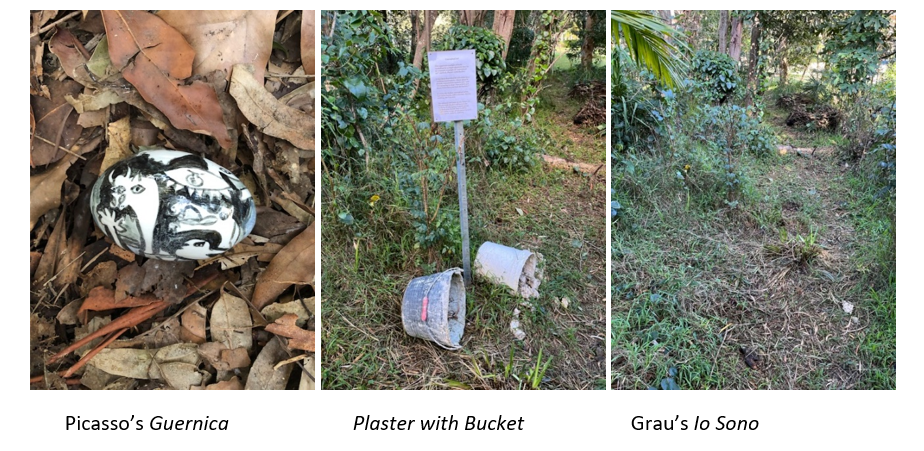
As Ana Cristina Vélez notes in this column, art not only encompasses painting and sculpture, but also literature. An important art form in literature is satire. It is therefore possible to turn this “nothing art” into something artistic by making fun of it. For example, in a littoral rainforest park at Stanwell Park, south of Sydney, there are the MATE Exhibitions (Modern Art Tributes on Eggs) where, during Covid when we could not go to art galleries, copies famous artworks were painted on porcelain eggs in giant nests constructed from invasive weeds and fallen sticks. But one day a vandal builder dumped buckets of old plaster in the bush along one of the tracks. We put up a sign next to it: “Conceptual Art. This apparent example of bush vandalism by a rogue plasterer may be an exquisite example of ‘conceptual art’, entitled Plaster with Bucket. It has been described by art critics as a ‘striking masterpiece, whose place is already cemented in modern art.’ Its meaning is clear: you have to get plastered before you kick the bucket.’ In 2001, the Italian conceptual artist, Salvatore Grau sold a vacuum, that is nothing for €15,000. The ultimate future of Plaster with Bucket will have to be made by Wollongong City Council whose curators may decide that it may be replaced by a copy of Salvatore Grau’s masterpiece, Io Sono, namely nothing.” The photos show the original artwork of the plaster and bucket and then the substituted copy of Grau’s masterpiece, nothing.

Comparte tu opinión

 Loading…
Buscar en Blogs
Blogueros notables
Mas votados


Todos los Blogueros
- CastroOpina
Por @castroopina
- Los que sobran
Por @Cielo _Rusinque
- Coma Cuento: cocina sin enredos
Por @ComíCuento
- Tenis al revés
Por @JuanDiegoR
- A calzón quitao
Por A calzón Quitao
- La Guía Astral
Por ACA
- Lloronas de abril
- El Peatón
Por Albeiro Guiral
- Unidad Investigativa
Por Alberto Donadio
- Detrás de Interbolsa
Por Alberto Donadio
- Alejandro Pinto
Por Alejandro Pinto
- Cura de reposo
- ¿Se lo explico con plastilina?
Por alter eddie
- Un Blog para colorear
Por Alvaro J Tirado
- Voces por el Ambiente
- Catrecillo
- Relaciona2
Por ANDREA VILLATE
- Zona Mixta
- Bike The Way
Por Andrés Núñez
- Ventiundedos
- El invitado
Por antojarcu
- Ese extraño oficio llamado Diplomacia
- La tortuga y el patonejo
Por Baba
- Bajolamanga.co
Por Bajolamanga
- 300 GOTAS
Por Bastián Baena
- Con-versaciones
Por Bat&Man
- Corazón de mango
- Mi Opinión
Por Ben Bustillo
- Bernardo Congote
Por Bernardo Congote
- El Hilo de Ariadna
- El Río
Por Blog El Río
- Un Punto de Cruz
Por buscobeca.com
- Mirabilia
- Cara o Sello
Por Caraoselloblog
- Dirección única
- Media & Marketing
Por Carlos Castillo
- Hundiendo teclas
- Colegio de Estudios Superiores de Administración
Por CESA
- La Sinfonía del Pedal
- Follamos, luego existimos
- Colirio
Por colirio
- Colombia de una
Por colombiadeuna
- El Mal Economista
Por columnistas eme
- Palabra Maestra
- Olas y Ecos
Por dafevid
- Mercadeando
- Filosofía y coyuntura
- En contra
Por Daniel Ferreira
- Claudia Palacio
- De Sexo Hablemos
Por desexohablemos
- De ti habla la historia
- Plétora
- Las palabras y las cosas
Por Diego Aretz
- Yo veo
- Tejiendo Naufragios
Por Diego Niño
- Líneas de arena
- Desde la Academia
Por Economia
- Destellos de un mundo en mutación
- It was born in England
Por Eduardo Ustáriz
- Cuestión digital
Por Edwin Bohórquez
- El Mal Economista
- El MERIDIANO 82
Por El meridiano 82
- ESTADO DE COMA
Por Eliana Samacá
- El Magazín
Por elmagazin
- La vaca esférica
Por eltrinador
- El Mal Economista
Por EME
- Otro mundo es posible
Por Enrique Patiño
- Actualidad
- Gramófono cultural
- Tolima-Tolimán
Por FabiolaH
- La agenda del CFO
Por Felipe Jánica
- Dos o tres cosas que sé de cine
Por fgonzalezse
- República de colores
- Más que fotos
Por Gabriel Aponte
- La Franja De Gaso
Por Gaso
- cafeliterario.co
- Embrollo del Desarrollo
Por Gudynas Eduardo
- Hernán González R
- Calicanto
- Humedales Bogotá
Por humedalesbogota
- Ecuaciones de opinión
- Internet pa’l diario
- El bosque es vida- IRI Colombia
Por IRI Colombia
- Meditaciones Absurdas
- Deporte en letras
Por Iván Gutiérrez
- Pazifico, cultura y más
- Conversar, Sentir y Pensar…. Desde el SUR
- Parsimonia
Por Jarne
- Ciudad Sostenible
Por Jen Valentino
- Más allá de la medicina
Por jgorthos
- George o nomics
Por Jorge Borrero
- La droga, ¿y Colombia?
Por Jorge Colombo*
- Hypomnémata
- Si yo fuera
- Utopeando │@soyjuanctorres
- Minería sin escape
- Políticamente insurrecto
- Cosmopolita
- Inevitable
- En segunda fila
- Actualidad
- AdverGlitch
- Sobrevivir a la Edad Media
- A la Palestra
- Ready player number two
Por JuanDLink
- lado oculto radio
Por ladoocultoradio
- La revolución personal
- Las Ciencias Sociales Hoy
- Ciencia para el buen vivir
- Liarte: diálogo sobre arte
- Una habitación digital propia
- Los perdidos
Por losperdidos
- En jaque
- Reencuadres
Por Manuel J Bolívar
- Putamente libre – Feminismo Artesanal
Por Mar Candela
- LA CASA ENCENDIDA
- Psicoterapia y otras Posibilidades
Por María Clara Ruiz
- Política
Por Maria MesaR
- Bienestar en tiempos de drones
Por Maria Pasión
- Desde el fogón
Por Maritornes
- Consideraciones políticas
Por Maylor Caicedo
- Ella es la Historia
Por Milanas Baena
- Mongabay Latam
Por Mongabay Latam
- Ojo de pez
Por Mónica Diago
- Nadimcomics
Por nadimcomics
- NTT DATA: Tendencias disruptivas y nuevos modelos
- Con los pies en la tierra
- Tributos y Atributos
Por OSWALDO PEÑA
- El telescopio
Por Pablo de Narváez
- PauLab Laboratorio Digital / Un clic hace la diferencia
- El Último Verso
Por pavelstev
- Lloviendo y haciendo sol
Por Pilar Posada S.
- Esto mejora, pero no cambia
- El poder de la tecnología: Cómo nos cambia
Por Rafa Orduz
- La conspiración del olvido
- Don Ramón, psicología laboral
Por ramon_chaux
- Coyuntura Política
- Corazón de Pantaleón
Por ricardobada
- Reflexiones
Por RicardoGarcia
- DELOGA BRUSTO
- Apuntes de Ciencia
Por Santiago Franco
- La Acción Política de Educarse
Por Santiago Muñoz
- La Perla
Por Sebastián Gómez
- Óscar Sevillano
Por Sevillano
- Solteras DeBotas
Por Solteras DeBotas
- La cuestión animal
Por Steven Navarrete
- Tareas no hechas
Por tareasnohechas
- Tíbet de Suramérica
- El Cuento
- Blog de notas
Por Vicente Pérez
- El Blog del Cerebro
- Derecho para todos
- Conspirando por un mundo mejor
Blogueros de la Semana


Los editores de los blogs son los únicos responsables por las opiniones, contenidos, y en general por todas las entradas de información que deposite en el mismo. Elespectador.com no se hará responsable de ninguna acción legal producto de un mal uso de los espacios ofrecidos. Si considera que el editor de un blog está poniendo un contenido que represente un abuso, contáctenos.